Building Certificates Explained: Commencement vs Completion vs Occupancy vs Possession (RERA Guidelines)
When you invest in real estate or undertake a building project, understanding the legal certificates associated with the construction process is essential. These documents aren’t just bureaucratic paperwork — they safeguard safety standards, legal compliance, and your (buyer) rights. Under RERA (Real Estate Regulatory Authority) regulations, obtaining and maintaining these certificates at the right stages …
When you invest in real estate or undertake a building project, understanding the legal certificates associated with the construction process is essential. These documents aren’t just bureaucratic paperwork — they safeguard safety standards, legal compliance, and your (buyer) rights.
Under RERA (Real Estate Regulatory Authority) regulations, obtaining and maintaining these certificates at the right stages is mandatory. This blog helps you understand:
The Commencement Certificate is the first legal green signal you get from the local municipal authority (civic body) before starting any construction on a property. It confirms that the building plan is approved and meets:
Local zoning regulations – determine what can be built and where.
Ex : Building a commercial shop in a residential-only area is not allowed.
Environmental and safety requirements – focus on minimizing ecological impact and ensuring public safety.
Ex : Fire safety clearance for a high-rise building.
Structural and architectural norms – ensure that the building is designed and constructed to be safe, stable, and functional.
Ex : Staircase design with proper emergency fire exit.
Without this certificate, starting construction is illegal and could lead to penalties, demolition orders, or legal disputes.
2. Completion Certificate (CC or BCC)
The Completion Certificate is issued by the municipal authority once construction is finished. It confirms that the building has been constructed as per the approved plan and complies with:
Structural safety norms
Ex : Columns and beams designed to carry the building’s weight safely.
Fire safety standards
Mandatory fire exits and staircases kept clear and usable.
Municipal regulations
Ex : Building height and number of floors within permitted limits (or) Proper connection to municipal water, sewage, and drainage systems.
This certificate proves the building is legally constructed and fit for occupancy evaluation by the authorities.
3. Occupancy Certificate (OC)
The Occupancy Certificate is one of the most important certificates for end-users and buyers. It permits people to move into and occupy the building.
Confirms the building is safe for living or use
Certifies that all utility provisions (drainage, water, electricity, sanitation) are in place
Only granted when the building meets all regulatory criteria
It is issued after final inspections and fulfillment of all safety and utility compliance by the concerned authorities. For phased or multi-tower projects, authorities may issue Part OC for specific towers or wings that are fully complete.
Under RERA, promoters cannot hand over possession or collect full payment from the buyer without a valid Occupancy Certificate. Doing so is a violation and attracts penalties.
4. Possession Certificate
The Possession Certificate is a formal declaration from the promoter or builder to the buyer stating that the property is ready for physical possession. It is an internal hand-over document (not issued by the municipality or civic body) that marks the end of the promoter’s responsibility to deliver a vacant and usable space.
Buyer can physically take over the unit
All dues and legal prerequisites are addressed
Sometimes linked with RERA compliance before final payment
Developers often issue possession letters without OC or Part OC — courts/RERA have repeatedly held this does not create legal possession.
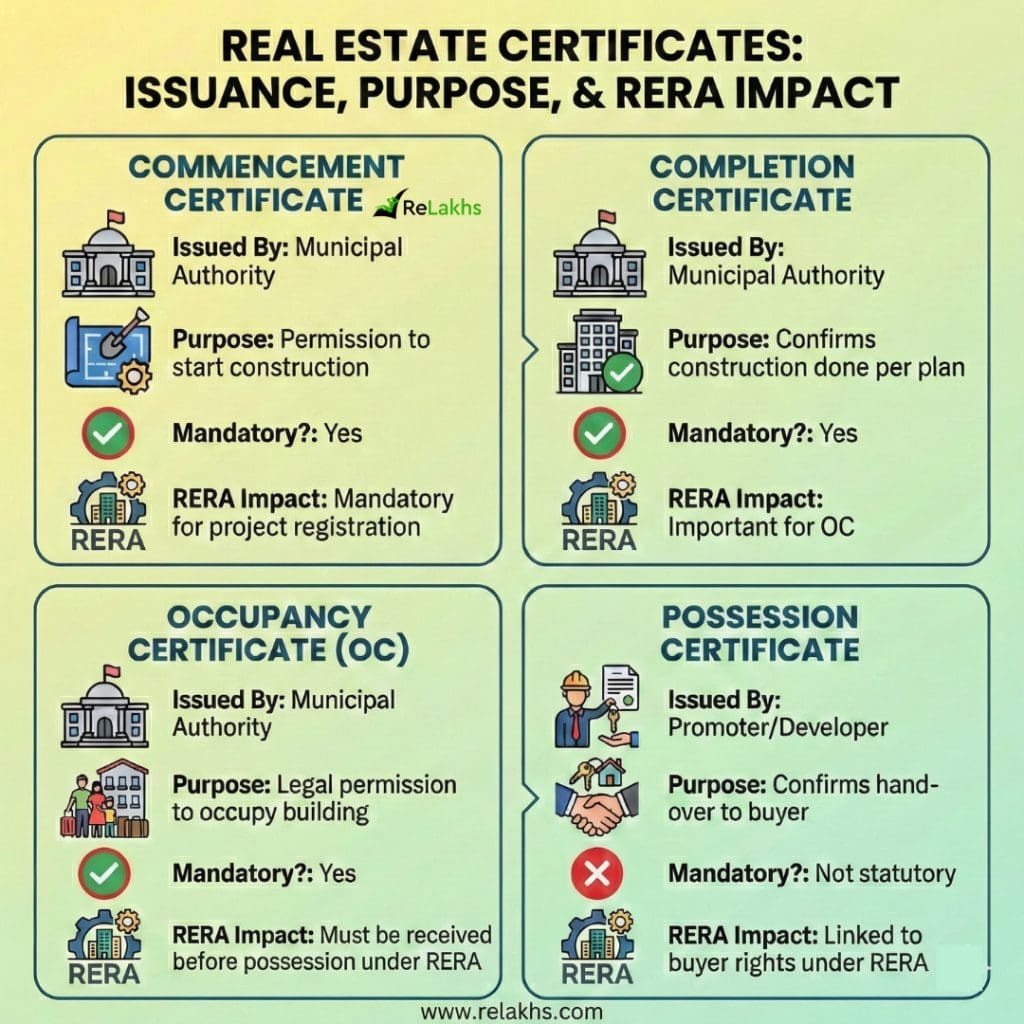
Commencement vs Completion vs Occupancy vs Possession Certificates
Certificate
Issued By
Purpose
Mandatory?
RERA Impact
Commencement Certificate
Municipal Authority
Permission to start construction
Yes
Mandatory for project registration
Completion Certificate
Municipal Authority
Confirms construction done per plan
Yes
Important for OC
Occupancy Certificate
Municipal Authority
Legal permission to occupy building
Yes
Must be received before possession under RERA
Possession Certificate
Promoter/Developer
Confirms hand-over to buyer
Not statutory
Linked to buyer rights under RERA
Understanding the difference between building certificates isn’t just technical knowledge — it empowers you to make informed investment decisions and protect your legal rights.
Occupancy Certificate allows you to live or use the building
Possession Certificate formally hands over the property to you.
Always verify these documents before signing agreements or making payments — especially in RERA-regulated markets.
Youtube Shorts | Checklist for Property Purchase in India
Continue reading:
Checklist of Important Property Documents in India | Legal Checklist for Property Purchase
Why Property Mutation Matters in India—Even If It Doesn’t Create Title Ownership!
(Post first published on : 23-Jan-2026)
Matilda Snider
Matilda Snider is a personal finance writer with a focus on financial planning, debt management, and saving for major life goals. After graduating with honors in Financial Planning from the University of Melbourne, Matilda worked as a financial advisor before transitioning into writing. Her content aims to simplify complex financial concepts for everyday readers, helping them take control of their finances and make informed decisions about budgeting, investing, and saving. Matilda is passionate about financial literacy and believes that everyone deserves access to the tools and knowledge to secure their financial future.