Immovable Property Gifts Above ₹45 Lakh Now Under SFT: What Changes from 1 April 2026?
Gifting immovable property—like land, plots, or houses—is super common in India. Families often do it out of love, for smooth succession planning, or to provide financial support. But not every transaction is genuine. Some use property gifts purely for tax planning. Others create proxy ownership (think benami-style arrangements). And in some cases, they’re used to avoid taxes or hide real ownership. …
Gifting immovable property—like land, plots, or houses—is super common in India. Families often do it out of love, for smooth succession planning, or to provide financial support.
But not every transaction is genuine. Some use property gifts purely for tax planning. Others create proxy ownership (think benami-style arrangements). And in some cases, they’re used to avoid taxes or hide real ownership.
Until now, these deals often escaped proper reporting. That’s exactly what’s changing now.
Property Transactions – What’s Changing from 1 April 2026?
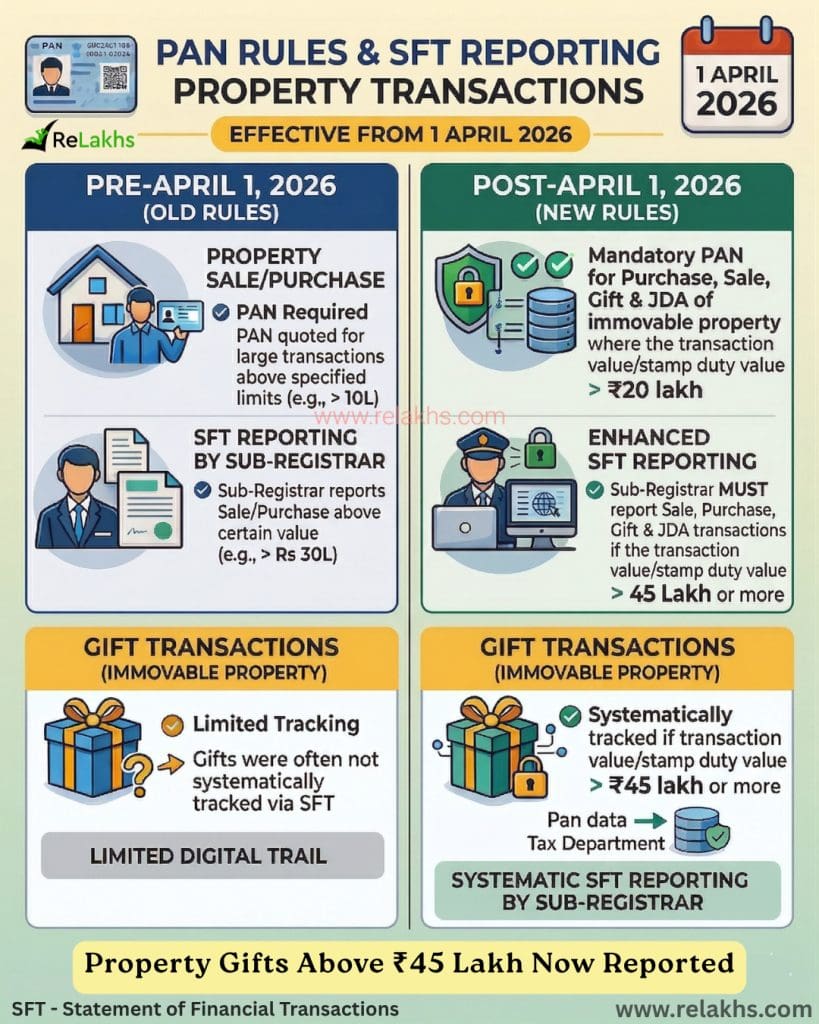
From 1 April 2026 and as per the revised SFT reporting rules, gifts of immovable property valued above ₹45 lakh will be reported under the Statement of Financial Transactions (SFT). While tax rules on gifts remain unchanged, high-value transactions will now be tracked through PAN linkage, increasing transparency and reducing tax evasion and proxy ownership structures.
So, Immovable property transactions will now face stricter reporting under the Statement of Financial Transactions (SFT).
Key changes in simple terms:
PAN is now mandatory for purchases, sales, gifts, and Joint Development Agreements (JDA) when the transaction value or stamp duty value reaches ₹20 lakh or more.
SFT reporting kicks in at ₹45 lakh—where sub-registrars must report sales, purchases, gifts, and JDAs to the Income Tax Department.
SFT (Statement of Financial Transaction) is a report filed by banks and financial institutions to the Income Tax Department regarding high-value transactions linked to your PAN. It acts as a tracking mechanism to ensure that your major investments and expenditures align with your declared income.
Don’t mix up these thresholds—they serve different purposes:
₹20 lakh = PAN required (that’s YOU providing it during the transaction).
₹45 lakh = SFT reporting starts (that’s the Sub-Registrar sending details to IT Dept).
Gift of Immovable Property Now Included in SFT
Earlier, gifts of immovable property often escaped consistent tracking with just a limited digital trail.
From April 2026, gifts worth ₹45 lakh+ will be fully tracked: reported by the sub-registrar, captured in SFT, linked to your PAN, and shared with the Income Tax Department.
What this means: A clear digital trail now exists, allowing authorities to match these transactions with your ITR.
Tax Rules on Gifts: No Change
The tax rules for property gifts haven’t changed one bit—only the tracking has gotten stricter.
Gifts from non-relatives worth more than ₹50,000? Still fully taxable as “Income from Other Sources.”
Tax rules have NOT changed — only tracking and compliance have become stricter.
Complete Details on Property Gift Deeds @ Property Gift Deed – All you wanted to know!
The Real Risk: Non-Disclosure & Proxy Transactions
If your gift transaction is genuine, you’re safe. If there’s intent to hide, the system will catch up. The biggest impact is on non-disclosure and misuse.
Problem scenario 1:
You receive property ≥ ₹45 lakh from a non-relative but skip reporting it in your ITR.
Now it triggers:
Automated mismatch alerts
Income Tax notices
Penalties (50-200% of tax evaded)
Real example: Mr. A “gifts” ₹60 lakh property to non-relative Mr. B. Mr. B doesn’t declare it.
If someone tries buying property in another’s name and calling it a “gift”: This screams proxy/benami structure—where the real owner funds it but hides behind a nominal owner.
Real example: Mr. A “gifts” ₹60 lakh property to non-relative Mr. B. Mr. B doesn’t declare it.
Mr. A purchases a property worth ₹25 lakh in 2024, but instead of registering it in his own name, he buys it in the name of his uncle (father’s brother), who does not have strong financial capacity. Since the value is below the earlier reporting threshold, the transaction does not get captured under SFT at that time.
Over the next two years, the property value increases significantly. After 1 April 2026, when the value reaches around ₹1 crore, the uncle gifts the same property back to Mr. A. Since gifts from relatives are tax-free, on the surface, this looks like a perfectly valid transaction.
However, with the new SFT rules in place, this high-value gift (above ₹45 lakh) gets reported and linked to PAN. The tax department can now see the entire trail — from the original purchase to the final transfer.
This raises obvious questions: How did the uncle initially afford the property? Who actually funded the purchase? Why is the property being transferred back?
Even though the structure looks valid (gift from a relative), the substance of the transaction suggests a proxy arrangement.
Conclusion: Transparency is the new normal.
From April 2026, property gifts of ₹45 lakh or more will leave a clear digital trail through SFT reporting by the sub-registrar, and the transaction will also be linked to PAN and shared with the Income Tax Department.
The overall shift is simple: better transparency and higher compliance. For genuine gifts, especially those received from relatives, there is usually no issue. But if the transaction is undisclosed or structured in a suspicious way, the risk of notices and penalties goes up significantly.
Continue reading:
Property Gift Deed – All you wanted to know!
Checklist of Important Property Documents in India | Legal Checklist for Property Purchase
(Post first published on: 11-April-2026)
Matilda Snider
Matilda Snider is a personal finance writer with a focus on financial planning, debt management, and saving for major life goals. After graduating with honors in Financial Planning from the University of Melbourne, Matilda worked as a financial advisor before transitioning into writing. Her content aims to simplify complex financial concepts for everyday readers, helping them take control of their finances and make informed decisions about budgeting, investing, and saving. Matilda is passionate about financial literacy and believes that everyone deserves access to the tools and knowledge to secure their financial future.