Property Valuation Guide: How Your Home Is Really Valued
You’ve probably seen the same property quoted at different prices. One person says ₹60 lakh, bank says ₹50 lakh, and the government value shows something else altogether. The same property can carry three different values—market value, guidance value, and valuation report value. And depending on what you’re doing, each one can matter in a different …
You’ve probably seen the same property quoted at different prices. One person says ₹60 lakh, bank says ₹50 lakh, and the government value shows something else altogether.
The same property can carry three different values—market value, guidance value, and valuation report value. And depending on what you’re doing, each one can matter in a different way.
So what’s the real value of a property? Whether you’re buying, selling, taking a loan, or planning taxes, getting this right matters a lot.
In this guide, let’s break down how property valuation actually works in India—simple, clear, and without the jargon.
What is Property Valuation?
Property valuation (PV) is the process of estimating the fair market value of a property at a given point in time. It is simply the process of finding out what a property is worth today.
And that value usually depends on;
Location
Property type (land / flat / commercial)
Market conditions &
Purpose of valuation
Now that we understand what property valuation means, the next question is—how is this value actually determined?
In India, a property doesn’t have just one value. It can have multiple values depending on the context. Let’s first understand the most important ones!
Market Value vs Guidance Value vs Circle Rate
What is Market Value?
Market value is the price a property can actually fetch in the open market. It moves with demand and supply, and it’s shaped by location, amenities, infrastructure, and future growth potential.
The best part is, it’s negotiable. In many cases, it also ends up higher than the government value, because this is the real-world selling price.
What is Guidance Value / Circle Rate?
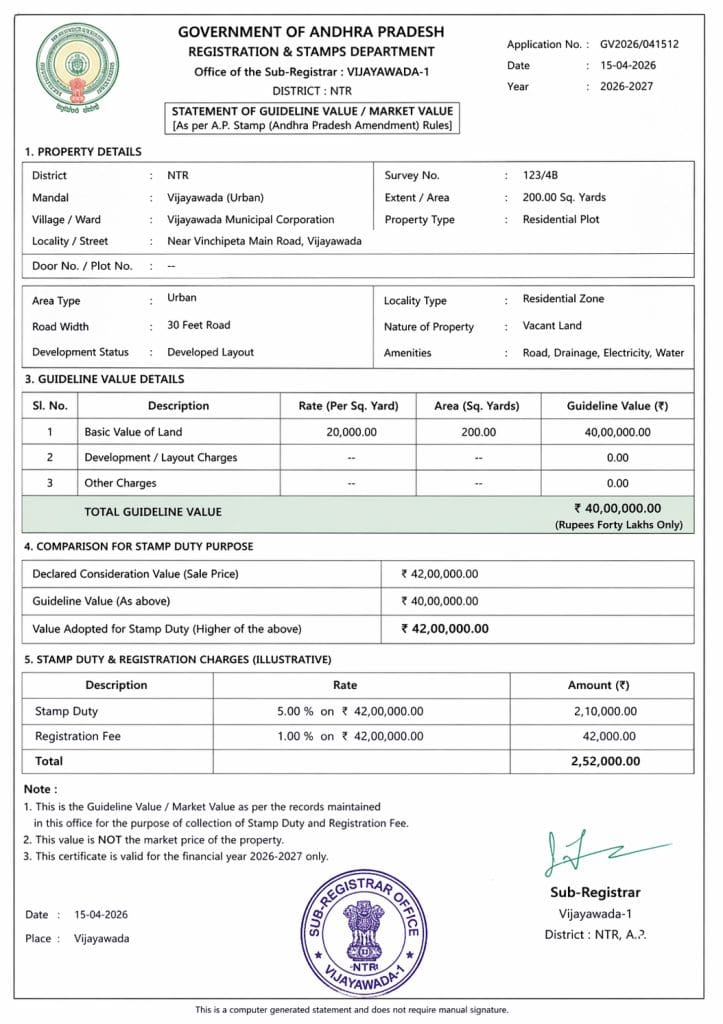
This rate is decided by the Sub-Registrar office and is used to calculate stamp duty and registration charges. It also helps prevent undervaluation, which is why you generally cannot register a property below this value.
Guidance Value—also called Circle Rate or GV—is the minimum value fixed by the government for a property. In Andhra Pradesh and Telangana, it’s usually called Guideline Value, in Maharashtra it’s known as Ready Reckoner Rate, and in many North Indian states, people call it Circle Rate.
Market Value vs Guidance Value (Quick Comparison)
Factor
Market Value
Guidance Value / Circle Rate
Who decides?
Market
Government
Nature
Dynamic
Fixed (revised periodically)
Usually
Higher
Lower
Usage
Buying / Selling
Stamp Duty
Reflects real price?
Yes
Not always
Note: Stamp duty is calculated on whichever is higher: Sale price OR Guidance value
From Value to Documentation
Understanding property value is great—but for loans, taxes, or disputes, you need it formally documented. That’s where the Property Valuation Report comes in.
What is a Property Valuation Report (PV Report)?
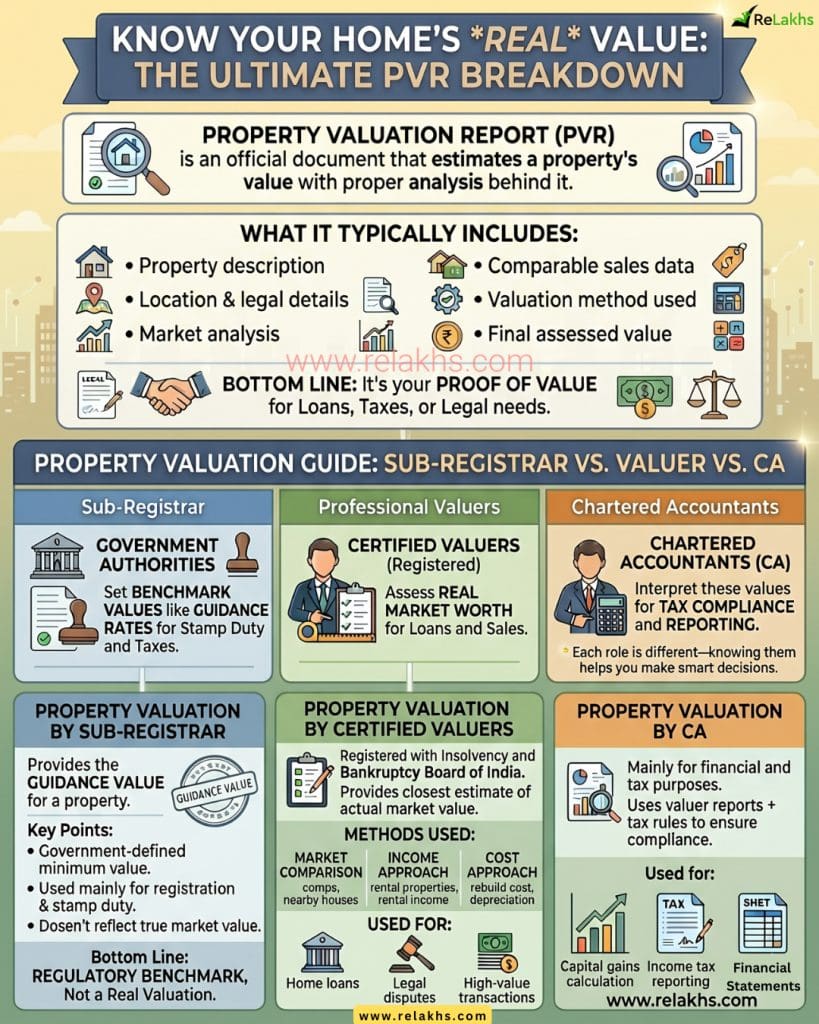
Property Valuation Report (PVR) is an official document that estimates a property’s value with proper analysis behind it.
What it typically includes:
Property description
Location & legal details
Market analysis
Comparable sales data
Valuation method used
Final assessed value
Bottom line: It’s your proof of value for loans, taxes, or legal needs.
Property Valuation Guide: Sub-Registrar vs Valuer vs CA
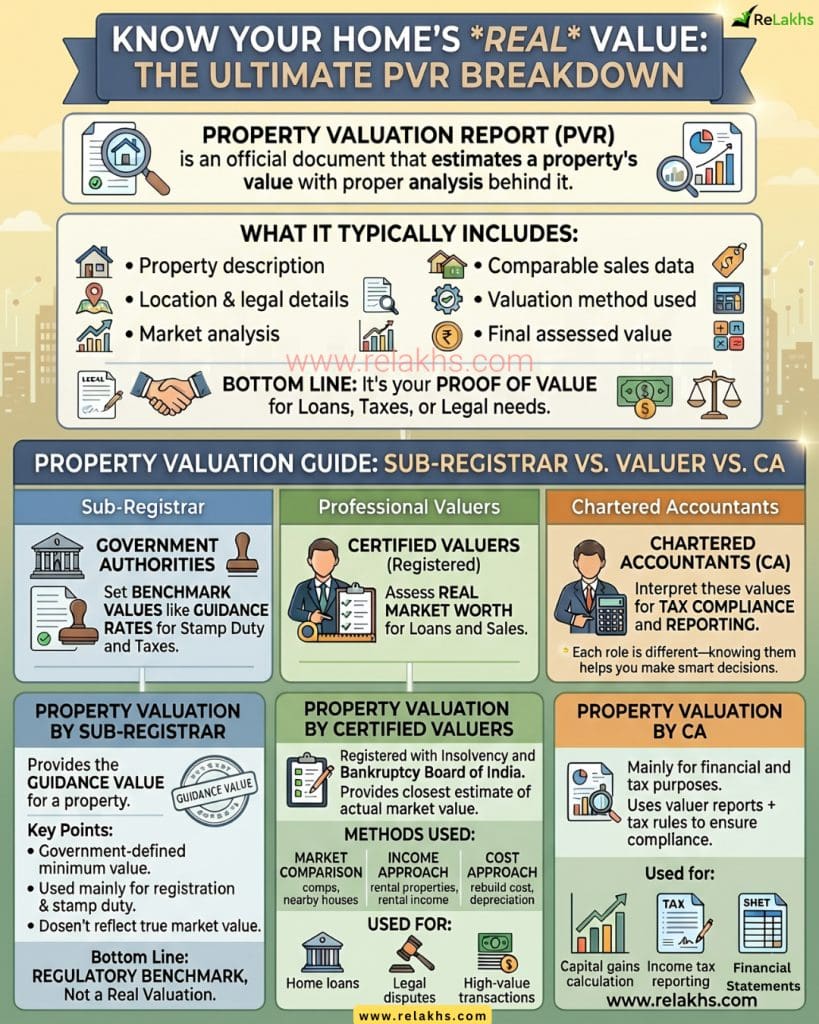
Property valuation isn’t done by one authority. Multiple players handle it for different reasons:
Government authorities (Sub-Registrar) set benchmark values like guidance rates for stamp duty and taxes.
Professional valuers (registered ones) assess real market worth for loans and sales.
Chartered Accountants interpret these values for tax compliance and reporting.
Each role is different—knowing them helps you make smart decisions.
Property Valuation by Sub-Registrar
Sub-Registrar provides the guidance value for a property.
Key points:
Government-defined minimum value
Used mainly for registration & stamp duty
Doesn’t reflect true market value
Bottom line: It’s a regulatory benchmark, not a real valuation.
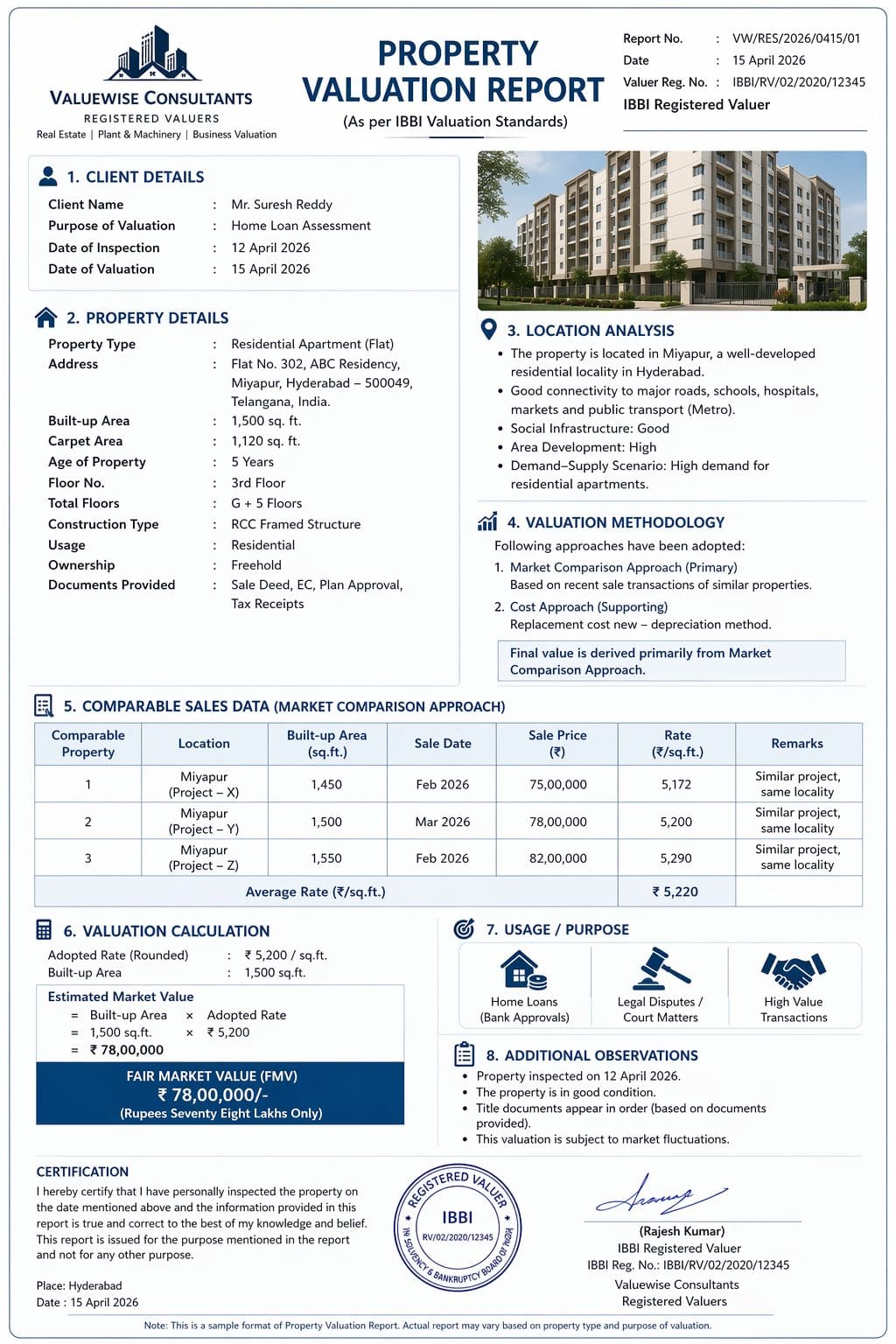
Certified valuers registered with Insolvency and Bankruptcy Board of India provide professional property valuation. This gives the closest estimate of actual market value.
Methods used:
Market comparison approach – Compares your property to similar ones recently sold nearby.
Income approach (for rental properties) – Estimates value based on rental income the property can generate.
Cost approach – Calculates cost to rebuild the property today, minus depreciation.
Used for:
Home loans (bank approvals)
Legal disputes
High-value transactions
Property valuation report by Certified Property Valuer | Sample Copy
Property Valuation by CA
Chartered Accountants handle property valuation mainly for financial and tax purposes. They generally use valuer reports + tax rules to ensure compliance.
Used for:
Capital gains calculation
Income tax reporting
Financial statements
CA cannot independently issue a formal PVR unless they are also a registered valuer with the Insolvency and Bankruptcy Board of India.
Where is Property Valuation Used?
Property valuation is used in many practical situations like buying or selling a property, taking a home loan, and calculating taxes. It is also important in cases such as family property division, legal disputes, and land acquisition. Simply put, knowing the correct property value helps you make better financial and legal decisions.
Key use cases:
Old / Ancestral Property → To determine current worth
Home Loans → Banks require valuation before approval
Litigation → Courts rely on valuation for fair judgment
Family Partition Settlements → Ensures equal distribution
Land Acquisition Compensation → Fair compensation calculation
Stamp Duty Calculation → Based on GV or higher value
Tax Compliance → Capital gains & fair market value
Final Thoughts
No property has one fixed value—it changes based on your purpose (sale, tax, loan, legal). Market value and guidance value can differ a lot. Always use the right valuation method for your situation.
Final thought: Property valuation isn’t just a number—it’s your foundation for smart financial decisions, legal clarity, and accurate tax compliance. Know when to use market value vs guidance value vs a proper valuation report, and you’ll avoid costly mistakes.
Continue reading:
Checklist of Important Property Documents in India | Legal Checklist for Property Purchase
Immovable Property Gifts Above ₹45 Lakh Now Under SFT: What Changes from 1 April 2026?
10 Important Things to do after buying a Real Estate Property
(Post first published on : 21-April-2026)
Matilda Snider
Matilda Snider is a personal finance writer with a focus on financial planning, debt management, and saving for major life goals. After graduating with honors in Financial Planning from the University of Melbourne, Matilda worked as a financial advisor before transitioning into writing. Her content aims to simplify complex financial concepts for everyday readers, helping them take control of their finances and make informed decisions about budgeting, investing, and saving. Matilda is passionate about financial literacy and believes that everyone deserves access to the tools and knowledge to secure their financial future.